Signal
Systems nominal · digital thread online
SyntheraOS · a Synthera Systems product

The operating system
for engineering.

A graph-first systems-engineering platform. Requirements, architecture, risk, V&V, cost and schedule on one connected model, read by an AI that cites every object behind its answers.

Design · Build · Operate · Learn
Scroll

-- the problem

Your engineering truth is scattered
across a dozen tools.

Requirements in one system, risk in another, cost in a third, operations somewhere else entirely. The thread breaks at every handoff, and the answer to "what does this change affect" lives in five places at once.

-- synthesis

One thread, end to end.

01 · today

Scattered.

Disciplines, documents and decisions, living apart.

02 · with SyntheraOS

Converging.

SyntheraOS draws every discipline onto one digital thread.

03 · the result

Synthesized.

One coherent system. Every link traceable to its source.

-- why now

Built to retire
the document era.

Systems engineering still runs on disconnected documents and hand-kept matrices. SyntheraOS replaces that whole stack with one connected graph: the successor to the DOORS and Rhapsody era.

1990s → today

The document stack

  • Requirements in DOORS, models in Rhapsody, risk in Excel, schedule in MS Project, none of them synced.
  • "What does this change affect?" means a week of manual cross-referencing.
  • Traceability is a matrix that goes stale the day it is built.
  • The answer depends on who you ask, and nothing cites its source.

now · syntheraos

One connected graph

  • Requirements, architecture, risk, V&V, cost and schedule live as connected objects on one graph.
  • Change any object and its impact lights up across every discipline at once.
  • Traceability is the data model itself, never stale and never hand-kept.
  • An AI systems engineer answers from your own objects and cites every one.
0
engineering disciplines on one connected thread
0
graph holds the program, not a dozen documents
0
of AI answers traced to a source object
0
broken handoffs between disconnected tools

-- lifecycle

One system, the whole way through.

From the first need to the running asset, SyntheraOS holds the full lifecycle on a single thread.

01

Design

Frame the need. Shape requirements, functions and architecture with AI that traces every decision.

02

Build

Connect interfaces, risk, cost and schedule on one graph, so a change shows its impact everywhere at once.

03

Operate

Verify and validate every requirement, and keep the model coherent as the design is built.

04

Learn

Capture what you learn in operation and feed it back into the next design cycle.

Learn feeds the next Design. The lifecycle is a loop, not a line.

-- the platform

One platform,
the whole engineering surface.

SyntheraOS holds the entire program (needs, requirements, architecture, interfaces, risk, verification, cost and schedule) as connected objects on a single digital thread, with an AI systems engineer reasoning over all of it.

One traceable graph

Needs, requirements, architecture, interfaces, risks and tests on one thread. Click any object to walk what it affects and what affects it.

Explore the live thread ↓

An AI Systems Engineer

It reviews requirement quality, finds coverage gaps, drafts change requests and answers questions, each grounded in your own objects.

Requirements, scored as you write

Each requirement is checked against systems-engineering writing rules (ambiguity, atomicity, testability) and flagged for exactly what to fix.

Risk you can see

A risk register with a 5 by 5 likelihood-against-impact heat-map. The AI surfaces the risks that actually threaten the program.

A lifecycle tracker

An 18-stage spine (the Engineering GPS) shows where the program stands and what the next gate needs.

Interfaces, V&V and compliance

Define interfaces, plan verification and track compliance against the same connected model.

Cost and schedule on the thread

Cost breakdowns and the schedule live as connected objects, so a change shows its impact everywhere at once.

Domain-agnostic by design

The same model fits a desalination plant or a survey UAV. Describe a new program and the AI drafts a starter thread you refine.

-- capabilities, explained

Everything it does,
in plain language.

Ten capabilities, one connected model. Pick any one to see what it does, why it matters, and how it plays out on a real program: the Albatross-1 survey UAV.

One graph, every link traceable

What it isEvery need, requirement, function, component, interface, risk and test is an object on one shared graph, connected by the links your engineers actually draw.
Why it mattersTraceability stops being a spreadsheet you maintain and becomes the data model itself, so it is never out of date.
On Albatross-1REQ-SUB-014 connects up to the endurance need and down to the test that proves it, in two clicks either direction.

An engineer that reads your whole program

What it isA built-in AI reasons over every object in your graph. It answers questions, reviews requirement quality, finds coverage gaps and drafts change requests.
Why it mattersIt speaks only from your own objects, scores its own confidence and cites every source, so every answer can be trusted and checked.
On Albatross-1Ask "what is the biggest risk?" and it returns RSK-011 at confidence 0.82, citing the five objects behind the claim.

Every requirement scored as you write

What it isEach requirement is checked against systems-engineering writing rules for ambiguity, atomicity and testability the moment you type it.
Why it mattersBad requirements are caught at the source, not in a review months later when they are slow and expensive to fix.
On Albatross-1REQ-SUB-014 is flagged "not testable: state N+1 in measurable terms" before it ever reaches the build team.

Risk you can actually see

What it isA live register scores every risk on a 5 by 5 likelihood-against-impact heat map, each one linked to the requirements and tests it touches.
Why it mattersThe AI surfaces the few risks that genuinely threaten the program instead of leaving them buried in a spreadsheet.
On Albatross-1RSK-011, the shared power rail, sits top-right at 20 of 20 and links straight to the unrun demo VER-009.

Change one thing, see everything it touches

What it isBecause every object is connected, editing one lights up its full ripple: the requirements, interfaces, risks, tests and cost it affects.
Why it matters"What does this change break?" goes from a week of cross-referencing to an instant, complete answer.
On Albatross-1Add N+1 power redundancy and the graph immediately flags IFC-004, VER-009 and the cost line that move with it.

Plan, run and prove every requirement

What it isDefine how each requirement will be verified, capture the evidence, and track verification coverage across the whole program.
Why it mattersYou always know what is proven, what is pending and what has no method yet, with nothing slipping through to flight.
On Albatross-1VER-009, the in-flight power-loss demo, shows as unrun and blocks sign-off on the power requirements it covers.

A living model of the built asset

What it isThe twin keeps the model in step with the real, operating system, so the graph reflects what is actually flying, not just the plan.
Why it mattersWhat you learn in operation flows back into the thread and feeds the next design cycle, closing the loop.
On Albatross-1The twin, TWN-01, records real endurance per sortie and updates the margin held against REQ-SYS-002.

Snapshots you can trust and audit

What it isFreeze the whole program at any milestone as a versioned baseline, then compare any two to see exactly what changed.
Why it mattersReviews, audits and approvals run against a fixed, signed state, not a moving target.
On Albatross-1The PDR baseline and the current model sit side by side, every delta on RSK-011 and its requirements listed.

Bring your existing programs in

What it isImport requirements, models and trace data from the document-era tools, and the AI reconnects them into one graph.
Why it mattersYou do not start from zero or abandon decades of existing work to move onto the thread.
On Albatross-1The legacy DOORS module lands as connected REQ objects, ready for AI quality scoring on day one.

Budget and plan, on the same thread

What it isCost breakdowns and the schedule live as connected objects, linked to the requirements and risks that drive them.
Why it mattersA design change shows its cost and schedule impact at once, so trade-offs are made with real numbers.
On Albatross-1Adding the redundant power path updates CST-02 and the milestone it pushes, the moment you make the change.

-- the product

See the system at work.

Four real surfaces from the platform, shown on an example program: the Albatross-1 survey UAV. Click through them.

Command center

A live read on the whole project, the moment you open it.
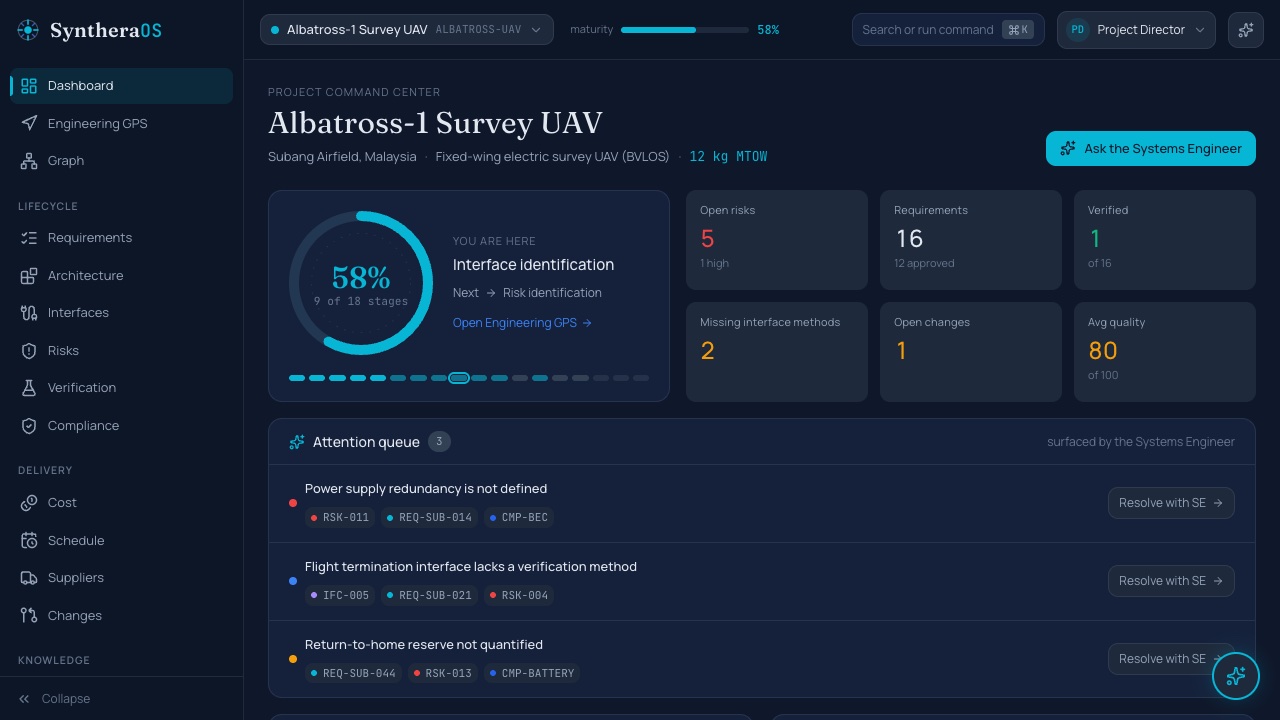
SyntheraOS dashboard for the Albatross-1 survey UAV: an engineering health index, risk and requirement metrics, and the AI attention queue flagging power supply redundancy.

AI systems engineer

Answers in plain language, and cites every source.
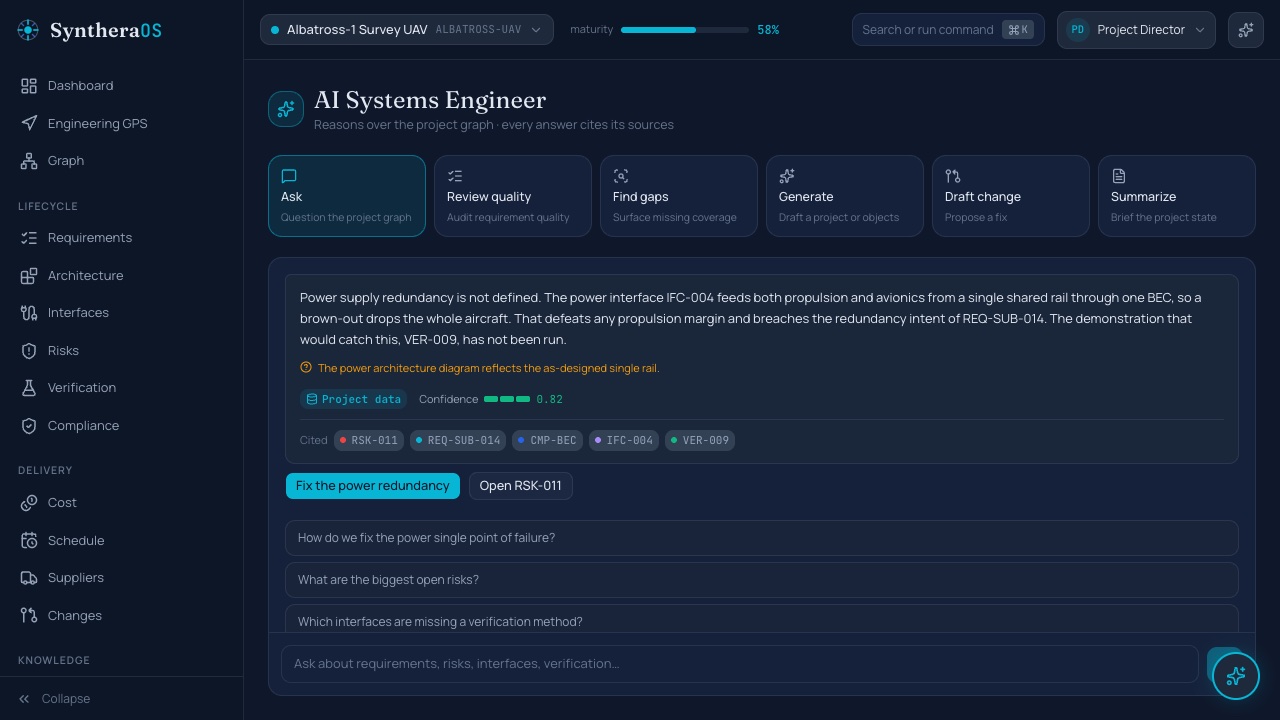
SyntheraOS AI Systems Engineer: a cited answer on the UAV power single point of failure at confidence 0.82, citing RSK-011, REQ-SUB-014, CMP-BEC, IFC-004 and VER-009.

Risk register

Every risk scored on likelihood against impact, AI-surfaced and traced.
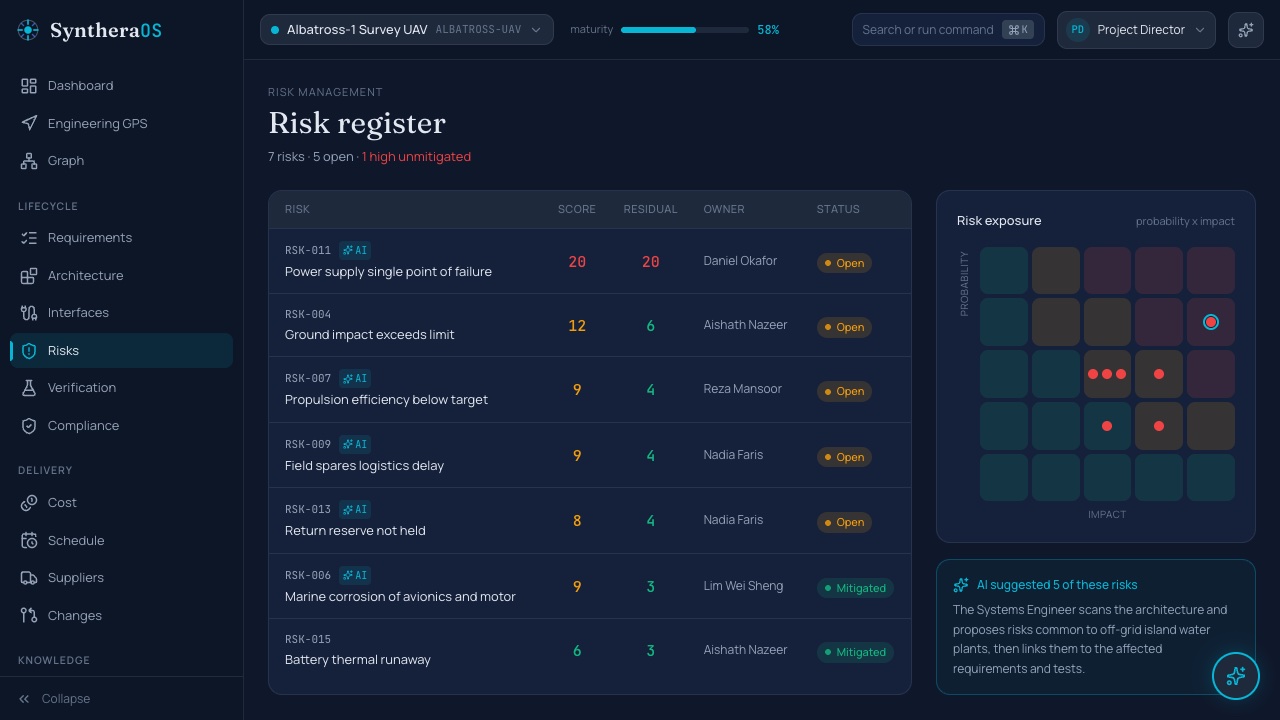
SyntheraOS risk register for the Albatross-1 UAV: a scored risk table led by RSK-011 at 20 of 20, beside a 5 by 5 probability against impact heat-map.

Requirements, quality-checked by AI

Every requirement scored for clarity and testability as you write it.
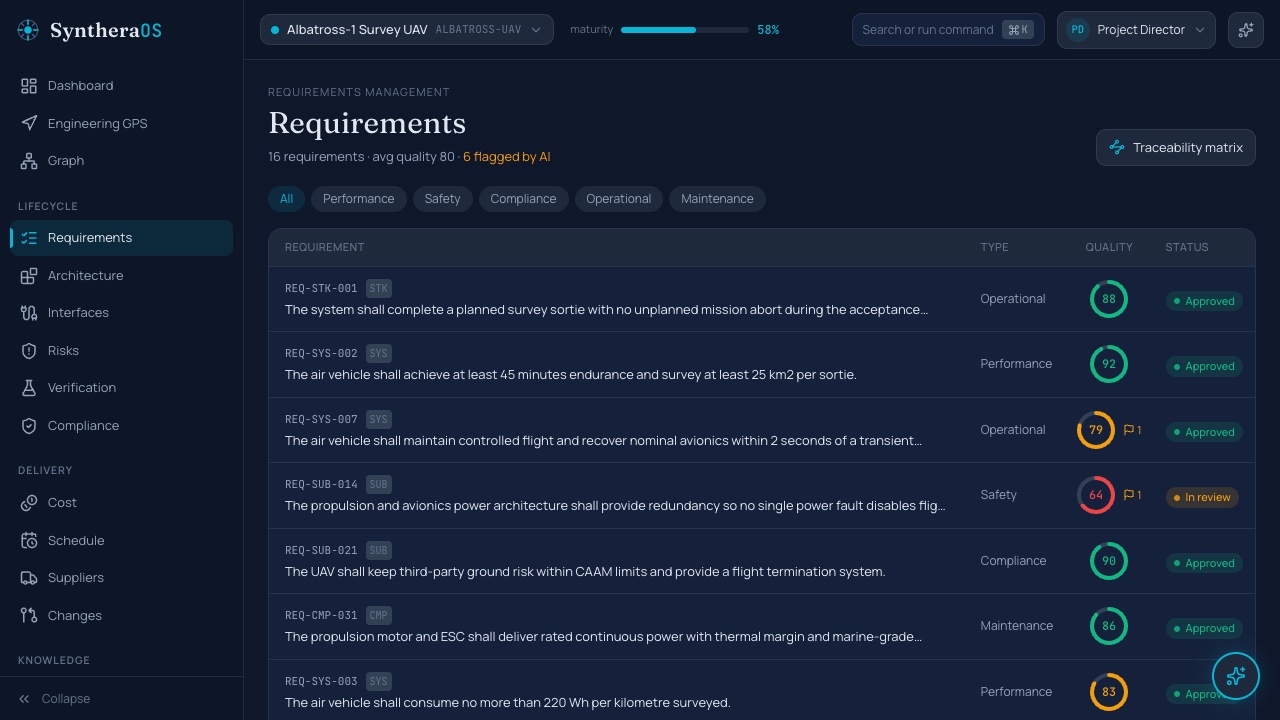
SyntheraOS requirements table for the Albatross-1 survey UAV: aerospace requirements each shown with a circular AI quality score, type and approval status.

-- the ai systems engineer

An AI that
shows its work.

Ask it anything about your program. It answers only from the objects in your graph, scores its own confidence, and links every claim to the requirement, risk or document it came from. When it is unsure, it says so.

› What is the single biggest risk to the Albatross-1?
The power supply is a single point of failure. Risk RSK-011 shows the BEC feeds propulsion and avionics from one shared rail, so a brown-out drops the whole aircraft. The demonstration that would catch this, VER-009, has not been run.
confidence 0.82
RSK-011 · power single point of failure
REQ-SUB-014 · N+1 power redundancy
CMP-BEC · shared power converter
IFC-004 · power distribution interface
VER-009 · in-flight power-loss demo, unrun
Try asking the Systems Engineer

-- the digital thread

One graph, fully traceable.

Needs, requirements, architecture, interfaces, risks and tests, connected by the edges your engineers actually draw. Click any node and walk the trace, forward to what it affects or backward to what affects it.

-- get a demo

See SyntheraOS
on your system.

A focused 30-minute walkthrough on a real engineering thread, from a need to a risk to the change that fixes it. Tell us a little about your team and we will set it up.

We reply within one business day.
Thanks. Your request is ready to send from your mail app.

The flagship of Synthera Systems.

Engineered intelligence, built in code · synthera-systems.pages.dev